Home › Guides › Slice and Loft
Choose by problemCan Loft Reduce a Slice?Why 9° curves more, and how far equipment can move it
Updated: Nov 6, 2026Contains affiliate links
You wanted distance, so you switched your driver from 10.5° to 9°. Then the trees on the right got closer. It's a common story, but it isn't necessarily your swing. Loft reduces a slice. And the less loft you have, the bigger it gets.
The reason is the ball's spin axis. For the same sidespin, the more backspin the ball has, the less the axis tilts. Through a gear nerd's eyes, I'll write how to sort out the cause by which clubs go right, and fixes in order of cost. When you've read it, you'll be able to decide whether to change your driver's loft.
What I tried with the driver: In October 2026, at a local golf shop, I turned the sleeve on a QUANTUM set to 9° (I did not turn it on the course). The slice was bending 25 yards to the right. Moving the sleeve one step from 9° to 10° cut it to 18 yards, but the carry dropped by 4 yards. Two steps made me hook the ball left, so I went back to one.
The Gear Nerd's Pick
Before you look for a draw-bias head, raise your driver's loft one step. A ball curves right because the spin axis tilts right. Axis tilt is set by the ratio of sidespin to backspin: with 500 rpm of sidespin, 2,000 rpm of backspin gives about 14°, and 5,000 rpm about 6° (a worked example from PING specialty shop LB). Loft that adds backspin is one of the few tools that cut curve without changing your swing. And for a slicer, the adjustable hosel that closes the face when you add loft works in the same direction.
Equipment for those who struggle with a slice
PING G440 K Driver (Low Dispersion; Also in 12°)
 Image: Rakuten Ichiba
- Tsuruya Golf (specialty store)RecommendedTsuruya product page

- AmazonAmazon product page
- Yahoo! ShoppingYahoo! Shopping product page
- Rakuten IchibaRakuten product page
- Rakuten Ichiba (used)Used product page
Buying from outside Japan? Sign up free for Rakuten Global Express (Rakuten's official forwarding service) and check out with its Japan warehouse address → full guide
Find a 12° driver
 Image: Rakuten Ichiba
- Rakuten Ichiba (used)RecommendedUsed product page
I couldn't find any new ones from Japanese retailers on Rakuten Ichiba right now.
Buying from outside Japan? Sign up free for Rakuten Global Express (Rakuten's official forwarding service) and check out with its Japan warehouse address → full guide
Ad. Links go to each store's product page ("Search ..." links go to search results). Price, shipping, stock and specs such as loft, shaft and number of clubs differ by store. Check the product page before you buy.

In this article
- Bottom line
- Count which clubs go right, and you can tell which side the cause is on
- A slice is "face to the right of the path." It curves by the same physics as a hook
- Reduce loft by 1.5° and the spin axis tilts from about 11° to about 14°
- For a slicer, an adjustable hosel that adds loft works in your favor
- If only your irons go right, suspect a flat lie angle
- Before you replace the head, you can try 4 fixes, starting from ¥0
- If every club goes right, separate face from path by the numbers
- Slice causes come in three types. Loft helps with the "open face" type
- Rough guide to a draw-friendly driver's numbers
- If changing clubs still doesn't fix your slice
- I added loft to the driver
- About the writer and sources
- FAQ
How to reduce a slice with loft: bottom line
Count which clubs go right first. If only the driver goes right, look at loft and the sleeve; if only the irons, lie angle; if every club, the movement side.
If you can add loft with the sleeve, hit 10 balls with that before buying a head. Replacing it comes up only if the right-side miss remains after you've added all you can.
The reverse applies too. I don't recommend a new driver to someone who curves 30 yards or more right with every club. It fixes part of the curve, and the cause remains.
Count which clubs go right, and you can tell which side the cause is on
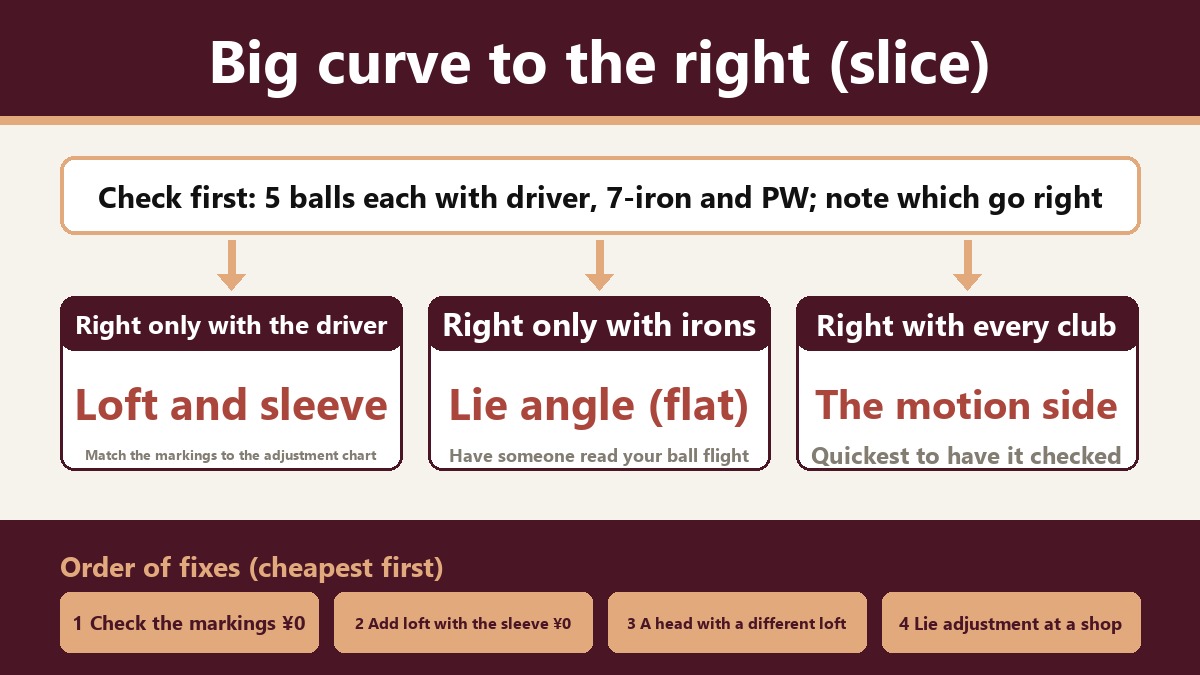
At the range, hit five balls each with the driver, 7-iron and PW. Write down, for each club, how many balls missed far to the right. You don't need any equipment.
- Only the driver goes right. The irons are straight. If only the club with the smallest loft of your 14 curves, start with loft and the sleeve (the part at the base of the shaft, called the "kachakacha" in Japan, that changes loft and lie).
- Only the irons go right. The driver is within what you can live with. Suspect a lie angle that's too flat (the tilt of the shaft when the club sits on the ground).
- Every club goes right the same way. Equipment scatter doesn't explain it. It's the movement side.
There's one more check you can do at home: whether the stamp on your driver's sleeve is at the standard position on the maker's adjustment chart. If you bought it used, had someone adjust it, or remember turning it yourself, start there.
A slice is "face to the right of the path." It curves by the same physics as a hook
How a ball curves is set by two directions at impact: where the face pointed, and where the head was moving (the path, or club path). The plane those two make is called the D-plane, and the Trackman launch monitor puts numbers on it.
In Trackman's official explanation, the launch direction is mostly set by the face direction. What sets the curve direction is the difference between face and path, face-to-path (the face angle minus the path angle). For a right-hander, plus means the face is open to the path and the ball curves right.
| Club | Face-to-path | Curve |
|---|---|---|
| Driver | +5° | about 44 yards right |
| Driver | −2° | about 19 yards left |
44 yards from 5°. A driver slice comes from a miss of just a few degrees.
A slice and a hook aren't different diseases. The sign of the difference is just reversed; the physics is the same. So, as in my article sorting out the duck hook, loft matters.
Another Trackman explanation lists swinging from out to in (left) as one reason for a fade or slice. But even with a leftward path, if the face points further left than that, the ball doesn't curve right. Is it the path to fix, or the face? I think you can't tell without looking at the numbers.
Reduce loft by 1.5° and the spin axis tilts from about 11° to about 14°
A ball curves by the amount it spins sideways. At the same time it spins forward and back. The more backspin, the less the axis tips sideways. PING specialty shop LB's explanation gives an example holding sidespin at 500 rpm and changing backspin: at 2,000 rpm the axis is about 14°, at 5,000 rpm about 6°.
So how much does backspin change when loft moves? Titleist explains officially that changing loft by 0.75° changes backspin by about 275 rpm. For a 1.5° step, scaled proportionally, that's about 550 rpm. I calculated with that. It assumes the same swing, with only loft changed.
| Driver Loft | Backspin | Sidespin | Spin-axis tilt |
|---|---|---|---|
| 9° (one step down) | about 1,950 rpm | 500 rpm | About 14° |
| 10.5° (baseline) | 2,500 rpm | 500 rpm | About 11° |
| 12° (one step up) | about 3,050 rpm | 500 rpm | about 9° |
At 9° the axis is about 14°; at 12°, about 9°. The swing is exactly the same. Even so, the tilt differs by about 1.5 times.
You cut loft to gain distance. That's moving yourself onto ground where the ball curves more easily. An article by MyGolfSpy Japan also says that when spin loft (the difference between the loft at impact and the angle the head comes in at) is low, the spin axis tilts easily and the ball curves more.
Some top-ranking explanations say "more loft reduces sidespin." I see it a little differently. It's not sidespin itself; it's the ratio of side to back that changes. So loft that adds backspin is what works, in that order.
There's a weak point too. Adding loft raises the ball and adds spin. People whose ball is already high and balloons without going forward are an exception. For them, reducing loft makes sense, so it's better to have the movement looked at before the loft.
For a slicer, an adjustable hosel that adds loft works in your favor
On a sleeve where loft and lie are linked on one axis, adding loft closes the face. TaylorMade's Japan official handling manual (the 2022 STEALTH series) gives numbers by position.
| Sleeve setting | Loft | Face angle |
|---|---|---|
| Loft +0.75° | +0.75° | 1.5° closed |
| Loft +1.5° | +1.5° | 3° closed |
| Loft +2° | +2° | 4° closed |
The face closes by twice the loft added. For golfers with a duck hook, that was an awkward design, because the curve-reducing effect and the face pointing left cancel each other out.
For a slicer, the same design works the other way. Backspin rises, the axis tilts less and the face at address points left. Both push in the direction of less curve to the right.
One pitfall: you dislike how closed it looks, so you grip it with the face turned back to square at address. As The GolfWorks explains, turning the face back toward open adds loft, and toward closed removes it. If you re-grip to match the look, the ball won't come off as the number you set. The way to use this design is to set the sole on the ground and grip it with the head pointing where it points.
There are systems like Titleist's SureFit that move loft and lie separately. They let you add loft alone, but they don't help close the face. The maker's adjustment chart tells you which kind you have.
If only the irons go right, suspect a flat lie angle
When the lie angle is flat (too far laid back), the toe of the head drops and the face points right. How much depends on loft. I calculated the face tilt when the lie angle is off by 1°.
| Club | Loft | Face tilt per 1° of lie angle |
|---|---|---|
| Driver | 10.5° | about 0.2° |
| 7-iron | 30 deg | about 0.6° |
| PW | 45° | about 1.0° |
| Sand wedge | 56° | about 1.5° |
For the same 1°, the sand wedge is more than 7 times the driver. Fixing a driver slice with lie angle barely works.
My 7-iron goes 160 yards (measured). Even with a 7-iron 1° flat, the face direction alone sends it only about 1.6 yards right (a guide calculated from my own measurement: 160 yards × tan 0.6°, curve not included). A few yards right is lie angle's turn. Thirty yards right isn't lie angle.
Lie angle should be set by the shape at impact, not at address. If your hands rise at impact, the heel lifts and you hit on the flat side. That's why PING's official fitting puts tape on the sole before you hit. I wrote how in the lie angle section of my duck-hook article.
Before you replace the head, you can try 4 fixes, starting from ¥0
- Check the sleeve stamp against the adjustment chart (¥0). If it's been turned toward less loft, go back to standard first.
- Add loft with the sleeve (¥0). If it's a linked design, the face closes too. Set the sole down, grip it with the head pointing where it points, and hit 10 balls.
- Switch to a head with different loft. If the right-side miss remains after you've added all you can with the sleeve, go one loft step up.
- Have the iron lie angle checked (at a workshop). For those whose irons alone go right. If you've just started lessons, wait until your movement settles.
If I were choosing
Models that offer up to 12° (for the PING G440, the MAX in 12°) Look at the loft options before the draw design. On PING's official pages, the draw-design SFT comes in 9° and 10.5°, and the MAX in 9°, 10.5° and 12°. For a slicer, having no 12° hurts. The weak point is that the ball flies higher and, for some players, rolls out less after the carry. It isn't for those who already hit it high.
 Rakuten Ichiba / AdPING G440 MAX
 Rakuten Ichiba / AdPING G440 SFT
Product images: Rakuten Ichiba (Ad). Tap an image to go to its Rakuten Ichiba product page.
Both cost ¥107,800 on PING's official site (incl. tax, checked Sep 29, 2026). The SFT isn't bad. If 10.5° gives you enough height and the ball still goes right, the SFT's draw design can fit. Before you pay ¥100,000, do 1 and 2 above.
Where to buy the PING G440 K driver
- Tsuruya Golf (specialty store)RecommendedTsuruya product page
- AmazonAmazon product page
- Yahoo! ShoppingYahoo! Shopping product page
- Rakuten IchibaRakuten product page
- Rakuten Ichiba (used)Used product page
Buying from outside Japan? Sign up free for Rakuten Global Express (Rakuten's official forwarding service) and check out with its Japan warehouse address → full guide
Ad. Links go to each store’s product page. Price, shipping, stock and specs (loft, shaft, set make-up) differ by store, so check the product page before you buy.
If every club goes right, separate face from path by the numbers
From here on I'll write only the commonly taught basics.
At a range with a launch monitor, there are two numbers to watch: face direction (face angle) and path (club path). If the path is well to the left, you're swinging out to in. If the path is near straight and the face is right, the face is hitting open. Same slice, different thing to fix.
You can't see your own path and face direction yourself. Once you've sorted it by the numbers, having someone look is fastest. Which comes first, equipment or lessons, is covered in my article on sorting by curve width.
Sign up here for the golf skills assessment with a trial lesson (60 min, ¥3,300; checked on the official site Sep 29, 2026): RIZAP GOLF

I haven't been to these places. I wrote only the prices published officially. For anyone who counted by club and found "only the driver goes right," I'd want you to try the sleeve wrench before spending ¥3,300.
Slice causes come in three types. Loft helps with the "open face" type
The top articles for "golf slice fix" divide the causes into the three types below. Loft and the adjustable hosel help with the type closest to an open face.
| Type | What is happening | Try this first |
|---|---|---|
| Open face | The path is fine, but the face is slightly open at impact | Add loft or switch to a draw-friendly design (the first half of this article) |
| Cut path | The club comes from outside on the downswing. The cause is said to be the right shoulder moving forward in the transition | Fix the motion. Before changing equipment, check with a lesson or video |
| Body rising | The body rises at impact, so the face tends to hit open | Telling a rising body from an equipment problem |
Counting which clubs go right (see "Count the clubs that go right to find the cause" in the first half) is the first clue for telling these three apart. If only the driver goes right, suspect the loft and club design. If the irons go right too, suspect the motion first.
Rough guide to a draw-friendly driver's numbers
Drivers for people who slice are designed so the face turns over more easily. The rough guide numbers are as follows.
| Item | Draw-friendly guide | Average the guide is based on |
|---|---|---|
| Center-of-gravity distance | Shorter than average | About 38 mm |
| Center-of-gravity angle | Larger than average (the deeper the center of gravity, the larger it gets) | About 20° |
| Loft | 10° or more | — |
| Lie angle | 60° or more (leaning upright) | — |
Loft and lie angle can be changed with the adjustable hosel and lie-angle adjustments described in the first half. Center-of-gravity distance and angle are set by the head's design and can't be changed by adjusting. On top of the loft and lie angle we looked at in the first half, picking a model with a shorter center-of-gravity distance and a larger center-of-gravity angle lines up the draw-friendly direction. If you're choosing from 2026 models, the driver ranking for slicers 2026 lines up each model's numbers.
If changing clubs still doesn't fix your slice
People for whom it's worth rechecking equipment
- Only the driver goes right and the irons are straight
- You cut loft to gain distance and the right side got worse
- The sleeve stamp is on the less-loft side, or you don't know whether it's standard
- Only the irons go a few yards right, and the strikes are the same every time
Who is better off not switching
- Every club curves far right the same way (equipment differences don't explain it)
- It scatters both right and left (having the movement looked at first is faster)
- Your ball is already high and balloons without going forward (adding loft makes it higher still)
- You go to the range only once a month (you can't separate the effect of a change from how you felt that day)
Adding loft shrinks the curve. But the habit of hitting with the face open remains. What equipment can cut is part of the curve.
At your next practice, hit five balls each with the driver, 7-iron and PW and write down how many went right. At which club did your right side start?
Update history
I added loft to the driver
At the standard 9°, my QUANTUM went right. Turning the sleeve to 10° cut the slice from 25 yards to 18. The 7-yard difference is about 28% of 25 yards (my arithmetic).
What troubled me was that the carry dropped 4 yards. Adding loft shrinks the curve, but it takes a little off the distance.
My mistake was moving it two steps and pulling the ball left. I went back to one step and settled at 10 degrees. My candidates were 10 and 11 degrees, and I hesitated between curve and distance. Curve decided it. Adjusting the sleeve is free.
If I chose again, I would pick 10 degrees. I recommend it to people whose slice sends them into the trees on the right. The only thing I confirmed here is that adding loft reduces the slice. The other sections are based on official figures and physics.
What one step of loft bought, and what it cost (arithmetic)
Line up the results above and subtract, and the trade becomes clear.
| 9° (standard) | 10° (one step more) | Gap | |
|---|---|---|---|
| Curve to the right | 25 yards | 18 yards | 7 yards smaller (about 28% less) |
| Carry | Baseline | 4 yards shorter | 4 yards shorter |
By the arithmetic, I gave up about 0.6 yards of carry for every yard of curve I removed (4 ÷ 7 = 0.57). For someone who keeps finding the trees on the right, I read that as a fair trade: a little distance for a smaller miss. Your driver may not work out the same. Move one step, hit five balls each way, and subtract the curve and the carry yourself.
If the ball still goes right after adding loft, it is time to switch to a draw-biased design. I lined up three of them by the numbers in Best Slicer-Friendly Drivers.
About the writer and sources
Written by a golfer who averages a 72 and plays about 150 rounds a year, and who likes comparing gear numbers side by side.
What I have handled is in the section "What I have actually handled". The numbers come from official materials, and the subtraction and sorting are mine. Last updated Nov 6, 2026.
FAQ
If I slice, should I add or reduce driver loft?
Add. With the same sidespin, the more backspin, the less the spin axis tilts and the less the ball curves. By my calculation, on a ball with 500 rpm of sidespin, going from 10.5° to 12° brings the axis from about 11° to about 9°, and going to 9° tilts it to about 14°. It isn't for people whose ball already flies too high.
How many steps of loft should a slicer add to the driver?
Start with one step. On my QUANTUM, going from 9° to 10° cut the miss to the right from 25 yards to 18 and shortened the carry by 4 yards. When I moved it two steps I hooked the ball left, so I went back to one. It depends on your clubhead speed and launch height, so hit five balls each way and check for yourself.
Does adding loft with the adjustable hosel reduce a slice?
On a sleeve where loft and lie are linked, adding loft also closes the face (in TaylorMade's official manual, +2° loft closes the face angle by 4°). For a slicer, the added backspin and the face pointing left work in the same direction. Be careful: if you grip it with the face set back to square at address, you lose the loft you added.
9° or 10.5°: which for a slicer?
10.5°. A 1.5° loft difference is about 550 rpm of backspin (my calculation, scaling Titleist's official "about 275 rpm per 0.75°"). The 9°, with less backspin, tilts the spin axis more easily and sends the ball right more easily even with the same swing. For how to choose if you don't slice, see "Driver 9° or 10.5°: which?", which works from angle of attack. If you add loft with the sleeve and still miss right, a model that offers 12° is also a candidate.
Is it the lie angle if only my irons slice?
If it only goes a few yards right, the lie angle may be too flat. Each 1° of lie angle turns the face right by about 0.6° on a 7-iron (30°) and about 1.5° on a sand wedge (my calculation). If it curves 30 yards right, lie angle doesn't explain it. Look at the difference between face and path.
What causes a slice in golf?
There are three broad causes: the face is open at impact, the club comes from outside on the downswing (a cut path), or your body rises at impact. Equipment fixes such as adding loft or switching to a more draw-biased design work best on the type closest to an open face.
What center-of-gravity distance suits a driver that is less likely to slice?
The guide is shorter than the average of about 38 mm. A center-of-gravity angle larger than the average of about 20°, a loft of 10° or more and a lie angle of 60° or more are said to suit slicers (ReRe, a guide as of August 2018). Check current models' figures on each maker's official spec table.
Ready to choose? Start here
Related reading
Is Your Club Causing the Duck Hook? Lie Angle, Weight and Adjustable Hosel
Driver loft, 9° or 10.5°? Angle of attack decides
How to Read a Golf Club Spec Sheet
Sources for this article
- Trackman official blog: What is Face-to-Path? (Sep 23, 2024. Driver +5° goes about 44 yards right; −2° goes about 19 yards left)
- Trackman official blog: 6 Trackman numbers every amateur golfer should know (Oct 21, 2024. Launch is mostly face direction; one reason for a slice is an out-to-in path)
- PING specialty shop Golf Shop LB: Seeing the Unseen, Part 4: Why the Spin Axis Tilts Less as Loft Increases (Jun 16, 2026)
- Titleist Japan official: How to Use the TSR Metal Precision Adjustment System "SureFit" (0.75° of loft ≈ 275 rpm of backspin; 16 loft and lie combinations)
- TaylorMade Japan official: Loft Sleeve [loft / lie / face angle adjustment] Manual (STEALTH series, 2022)
- The GolfWorks: Understanding and Fitting Driver Face Angle and Loft (relation between face direction and loft)
- MyGolfSpy Japan: A Special Way to Reduce Driver Spin (low spin loft tilts the spin axis easily)
- PING Japan official: G440 Driver (MAX 9, 10.5, 12°; SFT 9, 10.5°; SFT is a draw design; prices)
- CLUB PING official: the PING fitting process (hit with tape on the sole to see how the sole meets the ground at impact)
- RIZAP GOLF: Plans and pricing (golf skills assessment with a trial lesson, 60 min, ¥3,300)
- ReRe: Fixing a driver slice (Aug 21, 2018)
- Minna no Golf Digest: Coach Sho Aoki on fixing a driver slice
Read next
- A popular read on the same kind of gear:Voice Caddie Auto Pin (APL): Which Models and Which Courses It Works On
- Another well-read article on the same kind of gear:Garmin Approach S72: Release Date, Price and What Changed from the S70
- Next, a widely read piece on the same kind of gear:SPEEDER BOOST BLACK vs. the standard version