Home › Guides › GPS Watch or Laser Rangefinder?
Choose by problemGolf Rangefinders: GPS Watch or Laser First?A GPS watch gives you the center of the green. That can be one club off from the pin
Updated: Nov 7, 2026Contains affiliate links
Make your first one a laser. My choice is the Nikon COOLSHOT PROIII STABILIZED. The regular price at Nikon Direct is ¥64,900.
Whether your golf rangefinder should be a GPS watch or a laser comes down to the difference in what they measure. A GPS watch gives you the distances to the front, center and back of the green. Not the distance to that day's pin.
The center and the pin can be one club apart.
As a gear nerd who averages 72 with a best of 68 and spends most of his time looking into the numbers behind clubs and gear, I've lined up the 2 methods using official numbers. By the end you'll be able to decide which to buy first, and whether a GPS watch alone is enough.
A rangefinder is a tool that suits every golfer.With the number you need to pick a club right in your hand, you spend less time hesitating over every shot. Among them, the Nikon COOLSHOT PROIII STABILIZED is really good. It has image stabilization, a stated accuracy of ±0.75 yards, and shows the reading in 0.1 seconds. If you're on the fence, it's one worth buying.
What I've used:I've used the Garmin Approach S70 watch (about 8 rounds since September 2026), the Nikon COOLSHOT PROIII STABILIZED laser (about 30 rounds) and the Shot Navi STEADY (about 12 rounds since May 2026). On a new course in Boso in October, on a sunny day, the watch said 142 yards to the center of the green and the laser said 131 yards to a pin at the front. That's 11 yards, and it turned a 9-iron into an 8-iron. That same month, on the 5th at a hilly course in Chiba, the flag sat behind a tree on the right on my second shot and the laser couldn't read it. I switched to the S70, which showed 138 yards, hit a 9-iron and put the ball on the front of the green.
The Gear Nerd's Pick
Only a laser tells you the distance to the pin. That's why my first one is the Nikon COOLSHOT PROIII STABILIZED. A GPS watch calculates distance from a map of the course and your position. The map shows the shape of the green; it doesn't show today's pin. A laser hits the pin with light and gets the distance from the time the light takes to come back. It measures the very flag in front of you, so the number is right wherever the pin is cut. Among lasers I choose the Nikon because the body cancels out your hand shake. Published error is ±0.75 yards, with 0.1 seconds to a reading.
Where to buy my laser pick and the GPS watch I compared it with
Nikon COOLSHOT PROIII STABILIZED
 Image: Rakuten Ichiba
- AmazonRecommendedAmazon product page
- Rakuten IchibaRakuten product page
- Yahoo! ShoppingYahoo! Shopping product page
Buying from outside Japan? Sign up free for Rakuten Global Express (Rakuten's official forwarding service) and check out with its Japan warehouse address → full guide
Garmin Approach S50
 Image: Rakuten Ichiba
- Tsuruya Golf (specialty store)RecommendedTsuruya product page

- Rakuten IchibaRakuten product page
- Rakuten Ichiba (used)Used product page
- AmazonAmazon product page
- Yahoo! ShoppingYahoo! Shopping product page
Buying from outside Japan? Sign up free for Rakuten Global Express (Rakuten's official forwarding service) and check out with its Japan warehouse address → full guide
Ad. Links go to each store's product page ("Search ..." links go to search results). Price, shipping, stock and specs such as loft, shaft and number of clubs differ by store. Check the product page before you buy.

In this article
- Bottom line
- What do a watch and a laser each measure?
- How far does the gap between center and pin shift your club?
- When can't a laser measure? Of the three losses, the Nikon removes one
- Who is fine with just a watch?
- If you can't decide, count 3 things at your usual course
- By situation
- If you play in competitions, get a model that can turn elevation off
- Which is lighter in the pocket and easier on batteries?
- Buy the second one once the gaps in the first start to bother you
- What I learned using both
- About the writer and sources
- FAQ
GPS watch vs laser rangefinder: bottom line
Some people don't need to choose a laser.
If getting on the green is enough for you and you don't play differently for a front or back pin: what you want is the distance to the center, so a GPS watch is faster and easier.
If you often play courses with a lot of uphill or doglegged holes where you can't see the flag, a GPS watch also comes first. A laser can't measure what it can't see.
Price doesn't decide it. My pick, the Nikon, is ¥64,900; the GPS watch, the Garmin Approach S50, is ¥67,800. The difference is ¥2,900.
What do a watch and a laser each measure?
I'll put my laser pick next to 1 representative GPS watch. For the watch I chose the Garmin Approach S50. Both sets of numbers are from the official pages.
| What to compare | Laser (Nikon PROIII) | GPS watch (Garmin S50) |
|---|---|---|
| What it measures | The 1 point you aim at (the pin, etc.) | Front, center and back of the green |
| Accuracy | Published error ±0.75 yd | Calculated from the position on the map (the pin position isn't shown) |
| Weight | About 205g (without battery) | 29g |
| Battery | 1 CR2 battery | Rechargeable. About 15 hours with GPS |
| Targets you can't see | Can't measure | Can measure |
| Price (incl. tax) | ¥64,900 | ¥67,800 |
The most important line in the table is the first.
A GPS watch has maps of golf courses inside it. For the S50, that's more than 43,000 courses worldwide. It finds your position by GPS, calculates the way to the green on the map, and gives you 3 numbers: front, center and back.
The map isn't rewritten every morning. The pin moves every day.
So a GPS watch doesn't know where today's pin is. The S50 has a feature that lets you move the pin on the screen with your finger, but where you move it to is something you decide with your own eyes.
A laser is the opposite. It has no map; it simply hits the flag with light and turns the time it takes to come back into a distance. So as long as you can see the flag, it measures the same way at a course you're visiting for the first time, and wherever the pin is cut.
Look at the accuracy row too. The Nikon measures the flag itself and gives a figure of ±0.75 yards. A watch works out distance from a GPS position that shifts with the sky and surrounding trees, so its accuracy is a different question from accuracy to the flag.
How far does the gap between center and pin shift your club?
Let me work through an example. These aren't from a real hole; they're numbers for the sake of explanation.
Say the GPS watch shows 140 yards to the front, 155 to the center and 170 to the back. That's a green 30 yards deep.
If the pin is cut 5 yards from the front, it's 145 yards to the pin. That's 10 yards different from the 155 to the center.
10 yards. That's one club.
With irons spaced 4° apart in loft, the gap between clubs is about 12 yards (from the common rule of thumb of about 3 yards per 1°; the same assumption as the Club Setup Check).
Trust the center number and take a 7-iron, and by this math you have one club too much for a front pin: you're on the green, but with a 10-yard putt left.
The more you want to lower your score, the more these 10 yards matter. This is why my first one is a laser.
Even with a GPS watch, you can narrow the gap by looking at the front and back numbers and estimating the pin position by eye. But an estimate is an estimate. It doesn't match a number from light hitting the flag.
When can't a laser measure? Of the three losses, the Nikon removes one
Lasers have weaknesses, too. I'll lay them out without hiding any.
It can't measure what it can't see
On an uphill shot you can see only the tip of the flag. The green is on the other side of the trees. On holes like these, a laser can do nothing. A GPS watch gives you the distance from the map even when you can't see the target.
Distances to the front and back of ponds and bunkers are another thing a GPS watch does well. With a laser you can measure them by aiming at something on the edge, but it takes more effort.
It takes effort to aim
Take it out of your pocket, look through it, press the button. With a GPS watch you just look at your wrist. The GPS watch wins this one.
When your hand shakes, it measures what's behind the flag
If you aim at a target 150 yards away and your hand moves 0.5°, the point the light hits shifts about 1.3 yards sideways (my calculation: 150 yards × tan 0.5°). A flag is thin. Light that misses it carries on to the trees behind.
Nikon has removed this weakness inside the body.
The official explanation is that it "reduces the shaking of the view in the viewfinder caused by hand movement and, at the same time, also corrects the shake of the emitted laser beam." In other words, it steadies not just the view you see but also the direction of the light going out.
This part is really well done.
The moment it measures the flag, a mark lights up in the viewfinder and the body vibrates, and the number appears in 0.1 seconds. The time spent wondering "Did I just measure the flag, or a tree?" goes away. ±0.75-yard accuracy only means something once the light hits where you aimed. This is a unit that builds in that precondition on the machine's side.
I'll write about the weak points, too. About 205g is noticeably heavy in a pocket. The battery is a CR2, not rechargeable. If you want something lighter, Bushnell's Pinseeker Pro XM Jolt is 192g and rechargeable (published error within ±1 yard). If you want lighter still, the FineCaddie J2000 is 113g.
Who is fine with just a watch?
I'm not looking down on GPS watches. For the right person, one is more useful than a laser.
- People who are happy to land anywhere on the green.What you need is the distance to the center. A look at your wrist and it's there.
- People who often play courses with many holes where you can't see the flag.
- People who want to decide whether to lay up from the distance to a pond or bunker.
- People whose pre-shot rhythm is thrown off by taking a device out and putting it away.
The S50 is 29g. Light. It runs about 15 hours using GPS, so at 5 hours a round, that works out to 3 rounds without charging (my calculation).
The GPS watch's old weakness, "it doesn't know the pin," has started to change, too. Since Oct 9, Voice Caddie has been running a service that sends the day's pin positions, as set by the golf course, to the watch. At launch, about 504 golf courses are supported and it's free to use (confirmed with the official source on Oct 9). If the courses you play are supported, that changes things. I've put the compatible models and conditions in the Auto Pin article.
If you're choosing a GPS watch, the Garmin Approach S72, with a large screen that even shows swing numbers, is also a candidate. It's 48g in 47mm, with about 20 hours in golf mode.
If you can't decide, count 3 things at your usual course
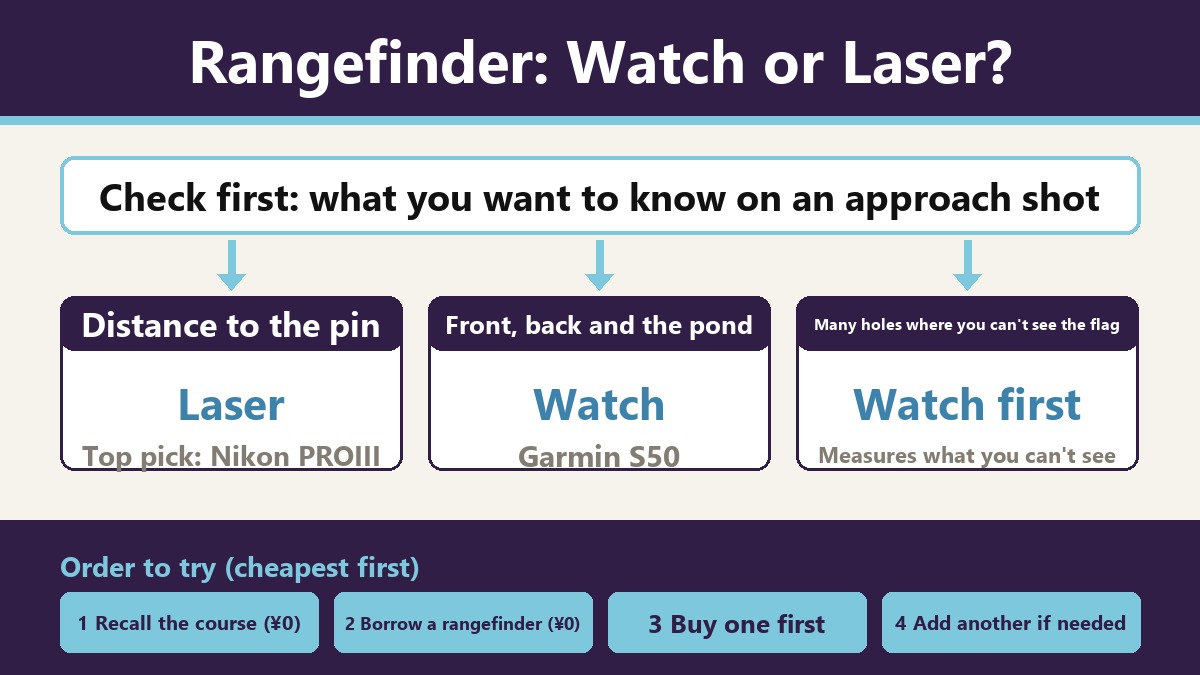
Before you buy, you can check for ¥0. Think back over the 18 holes of a course you play often.
- From where you hit your second shot, on how many holes can't you see the flag?If it's 6 or more, a laser is unusable 1 time in 3. The GPS watch comes first.
- Do you change clubs depending on whether the pin is front or back?If you do, a laser's number feeds straight into your club choice.
- Borrow a playing partner's rangefinder for just 1 hole.If looking through it to measure doesn't bother you, a laser; if it's a hassle, a GPS watch.
I think No. 3, borrowing, is the quickest. More than specs, measuring once with your own hands tells you a lot.
One thing to say up front. Changing your rangefinder won't improve your ball striking.
Someone whose 7-iron varies from 145 yards to 175 yards doesn't need ±0.75 yards. If your distance for each club isn't settled yet, that comes first. At a range with ball-flight data, write down your distance with each club, 10 balls apiece. The rangefinder can wait until after that.
Which is lighter in the pocket and easier on batteries?
How easy it is to carry also decides whether you keep using it. Here are weight and battery side by side.
| What to compare | Laser (Nikon PROIII) | GPS watch (Garmin S50) |
|---|---|---|
| Weight | About 205g (without battery) | 29g |
| Battery | One CR2 battery (replaceable) | Rechargeable. About 15 hours with GPS |
| How you carry it | Take it out of a pocket or bag and hold it up | Stays on your wrist |
The weight gap is 176 g (205 − 29, my calculation). The Nikon is about 7.1 times as heavy (205 ÷ 29). At five hours a round, the watch gets through three rounds without charging (15 ÷ 5).
I keep the Nikon in the side pocket of my caddie bag and take it out only to measure. For the first few rounds I carried it in my right trouser pocket, but at about 205 g it bumped my thigh with every step and got in the way when I bent over a putt, so I moved it. It hasn't bothered me for bulk since.
On a sunny September afternoon, the S70's screen was hard to read in the backlight on one hole. Tilting my wrist a little to cast a shadow made it readable, so I just hit. The weight didn't affect my swing and I didn't notice it. As for sweat, the back of the band got a little stuffy late in a hot round, but it never made the screen hard to operate.
Where to buy the Nikon COOLSHOT PROIII STABILIZED
- AmazonRecommendedAmazon product page
- Rakuten IchibaRakuten product page
- Yahoo! ShoppingYahoo! Shopping product page
Buying from outside Japan? Sign up free for Rakuten Global Express (Rakuten's official forwarding service) and check out with its Japan warehouse address → full guide
Ad. Links go to each store’s product page. Price, shipping, stock and specs (loft, shaft, set make-up) differ by store, so check the product page before you buy.
By situation: which one can measure it, laser or watch?
I've put everything so far into one table of situations that come up on the course. In almost none of them does one type simply win.
| Situation | Laser (Nikon PROIII) | GPS watch (Garmin S50) |
|---|---|---|
| The flag is visible | Measures to the flag (error ±0.75 yd) | Shows front, center and back of the green |
| The pin is cut near the front or back | It measures the flag itself, so the number is right | In the worked example, the gap from the center is 10 yards (one club) |
| The flag is hidden (uphill, beyond trees) | Can't measure | Gives the distance from its course map |
| Front or back of a pond or bunker | Works if you aim at the edge (takes more effort) | Strengths |
| Effort before the shot | Take it out, look through it, press the button | Just glance at your wrist |
| Competitions | Choose a model that lets you turn off the slope display | The S50's official spec sheet lists a tournament mode |
One more thing: divide the price by how often you use it. Here is my case at 150 rounds a year, and a player at 20 rounds a year. It's the cost per round if you use the device for one year.
| Model | Price (tax included) | 150 rounds a year | 20 rounds a year |
|---|---|---|---|
| Nikon COOLSHOT PROIII STABILIZED | ¥64,900 | about ¥433 | about ¥3,245 |
| Garmin Approach S50 | ¥67,800 | about ¥452 | about ¥3,390 |
The two differ by ¥2,900. That's about ¥19 per round at 150 rounds a year and about ¥145 at 20 (2,900 ÷ 150, 2,900 ÷ 20). Not a gap worth agonizing over, so the real question is still whether you want to measure the flag or you play courses where the flag is often hidden.
If you play in competitions, get a model that can turn elevation off
Rule 4.3 of the Rules of Golf allows you to get distance with a rangefinder. What it doesn't allow is measuring elevation changes. If you display a distance adjusted up or down for an uphill or downhill shot, it's a breach.
So for competition, a model has to be able to turn the elevation display off. Bushnell's Pro XM has a slide switch on the left side of the body, so you can see from the outside that it's off. The Garmin S50 lists Tournament Mode in its official spec table.
One more thing. The Committee can ban rangefinders themselves by Local Rule. Read the terms of the competition you're entering first. Choosing a model comes after that.
First-time buyers, tournament players and budget shoppers
If it's your first rangefinder, settle your distance for each club first. While your 7-iron scatters across 30 yards, distances to the yard are wasted on you.
If you play in tournaments, choose a model that lets you turn off the slope display. The details are in the section "If you play in tournaments" below.
If you're on a budget, the two differ by only ¥2,900 (67,800 − 64,900), so choose by whether you can see the flag rather than by price. I compared five lasers in the rangefinder rankings, and the watch that shows the pin position is covered in the Auto Pin article.
Buy the second one once the gaps in the first start to bother you
Some people carry both. The laser for the pin, the GPS watch for ponds and the depth of the green. That does fill the gaps.
But together that's over ¥130,000. It's not a matter of getting both from the start; I think it's enough to use the first one for half a year and think again once you can clearly see where it falls short.
In order from the least money. Count the holes at your usual course where you can't see the flag (¥0). Borrow a playing partner's rangefinder (¥0). Buy rangefinder No. 1. If the gaps bother you, add the other type.
Three things to take away.
A GPS watch gives you the front, center and back of the green, not today's pin.
The gap between the center and the pin can be 10 yards = one club.
A laser can't measure what it can't see. If your courses hide the flag, the GPS watch comes first.
If it were me, I'd buy the Nikon first, to aim at pins. ¥64,900. Not cheap. Even so, only a laser lets you choose a club from a number taken by light hitting the flag.
On your next round, try counting the holes where you can't see the flag from your second shot. How many were there?
Update history
What I learned using both
I used the Garmin Approach S70 (about 8 rounds since September 2026), the Nikon COOLSHOT PROIII STABILIZED (about 30 rounds) and the Shot Navi STEADY (about 12 rounds since May 2026). I left Bushnell out of this.
Of the two lasers, the Nikon's display speed and stability matched the numbers. The STEADY is light at 116 g, and at about 150 yards it picked up the flag on the first try 7 times out of 10. I have left the watch out of this assessment.
I measured the gap between watch and laser on a sunny day in October at a new course in Boso. The watch showed 142 yards to the center of the green and the laser showed 131 yards to the pin at the front. The gap was 11 yards, and my club changed from a 9-iron to an 8-iron. The watch was the Garmin Approach S70, the lasers were the Nikon and the Shot Navi STEADY, and only the Nikon has image stabilization.
The watch gives the distance to the center of the green, but not the pin position. On days when the pin was at the front or back, I was a club off, so I started using the laser too. I used the watch to read the shape of the green as well.
A laser can't measure when the flag sits in front of trees behind the green. Then I switch to the watch. On some days my hand shakes and I measure past the flag. The STEADY was hard to read against the sun, so I held it with both hands to steady it.
On competition days, I turned off the Nikon's slope display and used distance only.
The S70 used about 10% of its battery over 18 holes. The Nikon's CR2 battery was replaced once, around the 20th round, in the roughly 30 rounds I used it.
In a monthly competition this June, I used the Nikon and switched the slope display off. I forgot to switch it off only once, in a practice round before a competition. Since then I always check the icon before the first hole.
My own experience shifts my advice on the first purchase a little. On a course you've never played, or one where flags often hide behind trees, there will be moments like the 5th in October when a laser can't read the flag. A watch doesn't depend on seeing the flag, so I find it fails less often. My pick above is the laser, but if the flags are hard to see where you play, put this point first.
On a course I haven't played before, I take out the watch first. On holes where I can see the flag, I then check the distance to the flag with the laser.
About the writer and sources
Written by a gear nerd who studies golf equipment, averages a 72, and plays about 150 rounds a year.
I re-read the numbers against the sources below on Oct 13, 2026. Last updated Nov 2, 2026.
FAQ
Which is more accurate, a GPS watch or a laser rangefinder?
For the distance to the pin, it's the laser. It shines its light on the flag itself, and the Nikon COOLSHOT PROIII STABILIZED has a published error of ±0.75 yd. A watch calculates the distance to the front, center and back of the green from a course map; only the laser measures the flag itself.
Do beginners need a rangefinder?
While your distance with each club isn't settled yet, there's no need to hurry. At the stage where your 7-iron distance varies across a 30-yard range, you can't make full use of distances to the yard. Write down your distance for each club first, and buy once that's settled. You'll get more for your money that way.
Do I need both a GPS watch and a laser rangefinder?
You don't need 2 from the start. Make your first one a laser if you aim at pins, or a GPS watch if many of your holes hide the flag, and add the other once it's clear where the first falls short. That's enough.
Can I use a rangefinder in competition?
Rule 4.3 of the Rules of Golf allows the use of a rangefinder to get distance. Measuring elevation changes is not allowed, so choose a model that lets you turn the elevation display off. Some competitions have the Committee ban rangefinders by Local Rule, so check the competition's terms first.
Is there a watch that shows where the pin is today?
Yes. Since Oct 9, 2026, Voice Caddie has offered a service that sends the pin position set by the course that day to your watch. At launch it covered about 504 courses and was free to use (checked on the official site on Oct 9). Check first whether your course is supported.
How much does a rangefinder cost per round?
At 150 rounds a year, the Nikon COOLSHOT PROIII STABILIZED works out to about ¥433 a round and the Garmin Approach S50 to about ¥452 (price ÷ 150, spread over one year). At 20 rounds a year, it's about ¥3,245 and ¥3,390.
On a course where you often can't see the flag, which should you buy first?
The watch. A laser can't measure what you can't see. If a course has six or more holes where the flag isn't visible from the second-shot spot, the laser is useless on one hole in three.
Ready to choose? Start here
Related reading
What Is Voice Caddie Auto Pin (APL)?
Garmin Approach S72: Release Date and Price
Sources for this article
- Nikon official: COOLSHOT PROIII STABILIZED overview (image stabilization, 0.1 seconds, release date)
- Nikon official: COOLSHOT PROIII STABILIZED key specifications (measurement accuracy, weight, power source)
- Nikon Direct: COOLSHOT PROIII STABILIZED (regular price)
- Garmin Japan official: Approach S50 (weight, battery life, distance to the green, Tournament Mode)
- Garmin Japan official press release: Approach S50 (price and release date, Jan 23, 2025)
- Garmin Japan official: Approach S72 47mm (weight, battery life)
- Bushnell Golf Japan official: Pinseeker Pro XM Jolt (error, weight, slide switch)
- FineCaddie official: J2000 specs (weight)
- R&A: Rules of Golf, Rule 4 (4.3 Use of Equipment)
Read next
- A popular read on the same kind of gear:Bushnell Pinseeker Compared
- Another well-read article on the same kind of gear:Best Golf Rangefinders Under ¥30,000 2026
- Next, a widely read piece on the same kind of gear:Best Golf Rangefinders 2026
Most read on this site
SPEEDER BOOST BLACK vs. the standard version