Home › Guides › How to Choose a Hybrid
Bag setupHow to Choose a HybridA "4" ranges from 20° to 23° depending on the brand
Updated: Nov 5, 2026Contains affiliate links
You bought a No. 4 hybrid, and it doesn't fly the distance you expected.The cause is that there is no industry standard for hybrid numbering. Even a "No. 4" differs by 3 degrees from one maker to the next.
At 23 degrees, a PING is a 4 and a XXIO is a 5 (H5). So pick by loft, not by number.
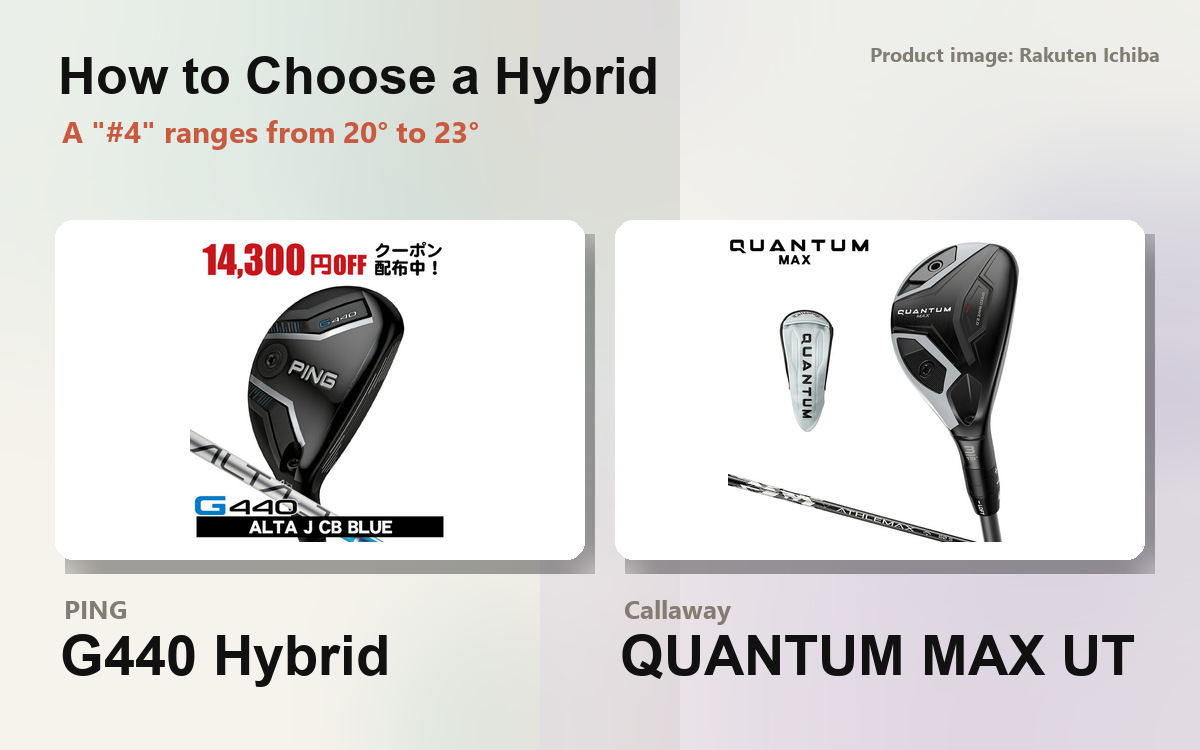
Hit:On Saturday, October 10, alone at an indoor range, I hit a PING G440 utility (21° as measured on TrackMan) about 20 times. Averaged over those shots at 46 m/s clubhead speed, it carried 205 yards, rolled out to 218 yards total, and spun at 4,200 rpm with a 13° launch. The first club I used was labeled "4" but measured 23°. Its distance overlapped my ZXi5 5-iron (24°), so I ruled it out. Pick by the number on the sole and you can buy the wrong club.
Choose by loft, and the gap between your irons and the hybrid closes, so on your second shot you can swing without agonizing over the club.
Where to buy this product
Srixon ZXi RKT Hybrid
 Image: Rakuten Ichiba
- Tsuruya Golf (specialty store)RecommendedTsuruya product page

- Rakuten IchibaRakuten product page
- Rakuten Ichiba (used)Used product page
- AmazonAmazon product page
- Yahoo! ShoppingYahoo! Shopping product page
Buying from outside Japan? Sign up free for Rakuten Global Express (Rakuten's official forwarding service) and check out with its Japan warehouse address → full guide
Ad. Links go to each store's product page ("Search ..." links go to search results). Price, shipping, stock and specs such as loft, shaft and number of clubs differ by store. Check the product page before you buy.
In this article
- Bottom line: choose by loft, not by number
- What Club Number Is a 23° Hybrid?
- Number-to-loft chart for five major brands
- How to find the loft you need
- How far does a utility go? A 23° is between 175 and 185 yards
- Wood-style or iron-style
- Hybrids vs. fairway woods
- Five major models compared
- How I choose my utility: the wrong buy, and how I build 13 clubs
- Hit: a "4" on the label measured 23°
- About the writer and sources
- FAQ
Bottom line: choose by loft, not by number
Stop shopping for "a 4 hybrid." Look up the loft of the longest iron in your set, then pick a loft 4–5° stronger.
If in doubt, go wood-style. Iron-style tends to suit players with plenty of head speed.
Three things that keep you from buying the wrong utility
- Look at loft.Take the loft of the longest iron you play now and add 4 to 5°, then look for that number. Ignore the number on the box.
- Start with a wood-type head.Wood-type heads launch the ball high, and the wide sole is forgiving on fat shots.
- Don't overlap distance with the club above.On the PING G440, the #7 fairway wood is 21° and the #3 utility is 20°, a 1° gap. Carry both and you're carrying two clubs for nearly the same distance.
Bottom line:Pick a wood-type head whose loft is 4 to 5° above your longest iron and doesn't overlap the club above it, and you avoid the mistake of buying by number and ending up with the wrong distance.
Once you narrow it to three criteria, you can look at 20°, 23° or 26° in a shop or online and judge for yourself which one fills the gap to your irons.
Earlier, in the wedge article, I showed that clubs with the same name, "pitching wedge," range from 41° to 47° in loft, a 6° spread. Hybrids have the same problem.
A 23° hybrid is a 4 or a 5 depending on the maker. Which number is it?
Answer first. 23° is a “4” from PING and a “5 (H5)” from XXIO. Same 23°, but the club number differs by one.
| Brand / model | Club number at 23° | Neighboring clubs |
|---|---|---|
| PING G440 | #4 (23°) | #3 is 20°, #5 is 26° |
| XXIO 14 | H5 (23°) | H4 is 20°, H6 is 26° |
| Titleist GT1 | No club number (labeled 23°) | 20°, 26° |
| TaylorMade Qi4D | No 23° | #4 is 22°, #5 is 25° |
| Callaway QUANTUM MAX | No 23° | 4H is 21°, 5H is 24° |
In iron terms, it is around the 5-iron in today's sets. The TaylorMade P790 (2025) 5-iron is 23°. In the Srixon ZXi5 the 4-iron is 22° and the 5-iron is 24°, and the PING G440 5-iron is 22° (each maker's official specs).
So it fits to think of a 23° hybrid as “a 5-iron replacement for people who can't hit their 5-iron.”
If you still carry a 5-iron and add a 23°, you end up with two clubs for the same distance. That is the one thing to watch.
When you buy, you can forget the club number. Just look at the loft number printed on the box or the sole.
How far does a 23° hybrid go? About the same as your current 5-iron
Plan on the same distance as your current 5-iron. In most iron sets, 23° is the 5-iron's loft.
Here's the math for me. My 7-iron goes 160 yards (my own measurement). Assuming 10 yards between clubs, my 5-iron goes about 180. A 23° hybrid covers that same 180-yard slot (an estimate calculated from my own measurement).
Add 20 yards to your 7-iron distance and you have a ballpark for 23°. If your gaps are bigger than 10 yards, add two of your gaps instead.
What number is 20 degrees? It can be a 3 or a 4
The same goes for 20 degrees. In the PING G440 it's the "3"; in the XXIO 14 it's the "4" (H4). The Titleist GT1 skips the number and just says "20 degrees." The TaylorMade Qi4D (#3 is 19 degrees, #4 is 22) and the Callaway QUANTUM MAX (3H is 19 degrees, 4H is 21) have no 20-degree option.
In iron terms, that's around a 4-iron. The 4-iron in the TaylorMade P790 (2025) is 20 degrees. It's the loft to add on top if your set only goes down to a 5-iron. It tends to overlap in distance with a 7-wood (around 21 degrees), so I wouldn't carry both.
Hybrid loft chart: number-to-loft for five major brands
I pulled the lofts of major 2025–2026 models from the manufacturers' official specs and lined them up.
| Loft | PING G440 | TaylorMade Qi4D | Callaway QUANTUM MAX | XXIO 14 | Titleist GT |
|---|---|---|---|---|---|
| 17° | #2 | #2 (custom) | ― | ― | ― |
| 18° | ― | ― | ― | H3 | GT2 |
| 19° | ― | #3 | 3H | ― | GT3 |
| 20° | #3 | ― | ― | H4 | GT1 |
| 21° | ― | ― | 4H | ― | GT2 / GT3 |
| 22° | ― | #4 | ― | ― | ― |
| 23° | #4 | ― | ― | H5 | GT1 |
| 24° | ― | ― | 5H | ― | GT2 / GT3 |
| 25° | ― | #5 | ― | ― | ― |
| 26° | #5 | ― | ― | H6 | GT1 |
| 27° | ― | ― | 6H | ― | ― |
| 28° | ― | #6 | ― | ― | ― |
| 30° | #6 | ― | ― | H7 | ― |
| 34° | #7 | ― | ― | ― | ― |
Look at the bold row. The club labeled "4" is 20° for XXIO H4, 21° for Callaway 4H, 22° for TaylorMade #4 and 23° for PING #4. That's a 3° spread.
A 3° difference works out to about 10 yards. You want "the same as my old 4," so you buy a 4 from a different brand, and now you can't hit your target distance. Same name, different club.
On top of that, the naming itself differs.
| PING | #2 / #3 / #4 / #5 / #6 / #7 |
|---|---|
| TaylorMade | #2 / #3 / #4 / #5 / #6 |
| Callaway | 3H / 4H / 5H / 6H / 7H |
| XXIO | H3 / H4 / H5 / H6 / H7 |
| Titleist | No numbers, loft only (18°, 21°, 24°…) |
Titleist skips numbers entirely and shows only the loft. It's an honest approach. I think the root of the confusion is the "number" label itself.
How to find the loft you need
Start with your current irons.
① Look up the loft of your longest iron
Check the loft of the longest club in your iron set (5-iron or 6-iron) on the manufacturer's official spec sheet.
For example, the T100 7-iron is 33°. A "7" with 29° of loft is a different club altogether.
Modern irons have stronger lofts, so a "5-iron" might be 24° or it might be 27°. Assume here and you'll get it wrong.
② Pick a loft 4–5° stronger
If your 5-iron is 25°, your hybrid should be 20–21°. If your 6-iron is 27° and you can only hit from there down, start at 22–23°.
A 4–5° loft gap works out to roughly 10–15 yards. US fitters also suggest keeping 10–15 yards between approach clubs, and I use that range as my guide for the steps between clubs.
③ Check that the gap to the club above isn't too wide
If you carry a fairway wood above the hybrid, check that gap too. As I wrote in the 3-wood article, FWs and hybrids tend to overlap in loft.
For example, in the PING G440 line the 7-wood is 21° and the #3 hybrid is 20°, just 1° apart. Carry both and you're lugging two clubs that go almost the same distance.
How far does a utility go? A 23° is between 175 and 185 yards
By number, a 23° sits between a 4 utility (22°) and a 5 utility (24°). In the guide from Golf Do, the 4 utility goes 185 yards and the 5 utility 175 yards, so 23° comes out at about 180 yards in between (a guide for men; it changes with swing speed and contact).
| Club | Loft | Typical distance (men) |
|---|---|---|
| 3 utility | 19° | 190 yards |
| 4 utility | 22° | 185 yards |
| 5 utility | 24° | 175 yards |
| 6 utility | 26° | 165 yards |
Even with the same 3 utility, distance changes a lot with swing speed.
| Head speed | Typical 3 utility distance |
|---|---|
| 32m/s | 135 yards |
| 34m/s | 150 yards |
| 36m/s | 165 yards |
| 38m/s | 180 yards |
| 40m/s | 195 yards |
The same article says distance drops by about 5 to 10 yards with each lower club number. The gaps in the table above are 5 yards from the 3 to the 4, 10 yards from the 4 to the 5, and 10 yards from the 5 to the 6 (my subtraction). From 32 to 40 m/s, 8 m/s apart, the 3 utility changes by 60 yards (135 to 195 yards), which is 7.5 yards per 1 m/s (my calculation). The slower the swing speed, the shorter the distance gets, even with the same club.
Some people say about 25° is the easiest to handle if you're buying your first one. As this article concludes, choose by loft rather than club number, and place it where it fills the distance gap from the longest iron you carry.
Wood-style or iron-style
This is the toughest call. I think about "will it launch?" first and "how do I attack the ball?" second.
First, which launches most easily. According to a club fitter, the order is:
Wood-style hybrid > iron-style hybrid > long iron
Iron-style hybrids have a hollow construction and are more forgiving than long irons, but they don't launch as high as wood-style.
In a GDO article, gear writer Motoharu Tajima points out:
"For amateurs with head speed of 40 m/s or less, even a wood-style hybrid of 20° loft or less may be hard to hit high"
Even wood-style is a struggle. That's the starting point. Iron-style models are said to "require the head speed and strike quality to hit long irons."
Here's how their characters compare.
| Wood-style hybrid | Iron-style hybrid | |
|---|---|---|
| Center of gravity | Deep (front to back) | Shallow |
| Ball flight | Launches easily | Slightly lower |
| Forgiveness | High (wide sole handles fat shots) | Less than wood-style |
| Workability | Low | High (easy to start on your target line) |
| Look at address | Like a wood | Feels like an iron |
| Best for | Most situations | Windy days, low, penetrating shots |
| Who it suits | Most amateurs | Players with plenty of head speed who hit down on the ball |
Wood-style is fine if in doubt. Structurally, too, a wood-style head with front-to-back depth makes it easier to place the center of gravity low and deep, which helps launch. Iron-style can wait. You'll want one once you feel your wood-style launches too high or struggles in the wind.
In practice, almost every hybrid on sale is wood-style. None of the five brands I looked at carry an iron-style model in their standard lineup. TaylorMade officially calls its Qi4D Rescue "wood-style" and explains that its "topline is set as thin as an iron's."
Where to buy the Srixon ZXi RKT hybrid
- Tsuruya Golf (specialty store)RecommendedTsuruya product page
- Rakuten IchibaRakuten product page
- Rakuten Ichiba (used)Used product page
- AmazonAmazon product page
- Yahoo! ShoppingYahoo! Shopping product page
Buying from outside Japan? Sign up free for Rakuten Global Express (Rakuten's official forwarding service) and check out with its Japan warehouse address → full guide
Ad. Links go to each store’s product page. Price, shipping, stock and specs (loft, shaft, set make-up) differ by store, so check the product page before you buy.
Hybrids vs. fairway woods
At the same loft, the longer club goes farther. That means the fairway wood.
| Club | Length | Loft |
|---|---|---|
| 5W | 42.0 in | 18–19° |
| 3U | 40.75 in | 18° |
| 7W | 41.5 in | 21–22° |
| 4U | 40.25 in | 20–21° |
A hybrid gives up a little distance in exchange for forgiveness and an easy look at address. Want distance? FW. Want to get it there reliably? Hybrid.
Which suits you depends on your angle of attack. This is fitter Hayato Ogura's guideline.
| Sweepers | Shallow angle of attack. Good match with fairway woods |
|---|---|
| Steep hitters | Hit down on the ball. Hybrids tend to suit better |
Five major models compared
| Model | Released | Price (tax included) | Loft options | Adjustability |
|---|---|---|---|---|
| XXIO 14 Hybrid | Nov 2025 | ¥50,600 | 18–30° | None |
| PING G440 Hybrid | Feb 2025 | ¥53,900–57,200 | 17–34° | Yes (8 positions) |
| Titleist GT2/GT3 | Feb 2025 | ¥55,000 | 18–24° | Yes (SureFit, 16 settings) |
| TaylorMade Qi4D Rescue | Jan 2026 | ¥57,200 | 17–28° | Yes (loft ±1.5°) |
| Callaway QUANTUM MAX | Feb 2026 | From ¥57,200 | 19–30° | Yes (all lofts) |
Look at the loft ranges too. The PING G440 runs from 17° to 34°, six clubs. XXIO 14 also goes up to 30°.
Hybrids around 30° can replace a 6- or 7-iron. If you struggle with long irons, it's worth considering hybrids this far down. XXIO added a new H7 (30°) with its 14th generation, and the ladies' line goes up to the H8 (35°). The maker must see demand there too.
If you want to spend less, last generation is the one to aim at. TaylorMade's Qi35 Rescue, as of Sep 28, 2026, is ¥33,000 at the official online store (was ¥50,600). On Sep 12 it was ¥24,200, and the official site noted it as "subject to a price increase from Sep 24." It is shown as a markdown, so check the official site once more before you buy. With a utility, what matters is not whether it's the newest but whether the loft links up with your irons. That's how I see it, so if the loft fits, I think last generation is plenty for many players.
How I choose my utility: the wrong buy, and how I build 13 clubs
My bag holds a utility I've used for a long time. I chose its loft and shaft to follow the flow of my irons. Brands number their clubs differently, so what I look at is the loft.
I've bought the wrong club by choosing on the number alone. Numbers and lofts differ by brand, so I hesitated, and I solved it by choosing on loft.
Picking a loft just above your longest iron makes sense to me. Check the gap by carry distance. The numbers I measured on clubs are in the next section.
Wood-style gets the ball up easily, while iron-style gives a lower, strong ball. From the rough, wood-style comes out more easily. The misses tend to be pulled shots and too little height.
Which fairway wood do you drop, and how many utilities do you carry? To people stuck on that, I answer: decide by looking at the gaps in your distances. My 13 clubs are set up so there are no gaps from the driver to the wedges.
“When in doubt, go wood-style” applies to many people, but there are exceptions. “Iron-style is for players with head speed” goes a little too far, so read it as a tendency.
Hit: a "4" on the label measured 23°
I used a PING G440 utility with a 60-gram-class S shaft. I hit it about 20 times on an indoor TrackMan as a stand-in for a long iron, and compared it with my ZXi5 5-iron.
The first one I used was labeled "4" and measured 23°. What I wanted was 21°, one club longer than my ZXi5 5-iron (24°). The 23° came up about 8 yards short in carry. I switched to a 21° and confirmed that the distances connect.
I hit the club labeled "4" on Saturday, October 3, at a local golf shop. No loft number was stamped on it. When I hit it indoors on a TrackMan, the screen read 23°, and I noticed the gap when I compared that with the "4" on the club.
I hit the 21° G440 the following week, on Saturday, October 10. I hit from about 3 p.m. for roughly an hour at an indoor range, alone, in a single session. With Pro V1 balls, I hit the G440 20 times, then the ZXi5 5-iron 10 times.
| Utility | Measured loft | Result |
|---|---|---|
| First one, labeled "4" | 23° | Overlapped the ZXi5 5-iron (24°) and fell about 8 yards short; ruled out |
| Second time: 21° | 21° | 205 yards carry, 218 yards total, 4,200 rpm spin, 13° launch |
Of the 20 shots, the best carried 211 yards and the worst, a slightly thin one, 192 yards. The ZXi5 5-iron I hit right after (24°, N.S.PRO MODUS3 TOUR 120 S, about 120 g) carried 190 yards, 15 yards short of the hybrid. Side to side, the hybrid spread ±9 yards and the 5-iron ±6 yards, so the 5-iron was tighter.
The 21° numbers also fit the math: it has 2° less loft than the 23° behind the 175 to 185 yards given in this article, so it goes farther.
The measured numbers so far all come from one session on October 10: 20 shots with the 21° G440. I measured the 23° club on only a few shots on October 3, and I measured no other lofts. The "175 to 185 yards for 23°" figure is a calculated estimate, not a measurement.
On Saturday, October 31, I also used the 21° G440 on a flat course in the Kanto area. It was a sunny 13°C round with two friends. On a par 4, I hit my second shot from a flat fairway with about 210 yards left. It carried about 205 yards and stopped short of the green, a good shot.
Into a headwind from the rough at 170 yards, the hybrid hit behind the ball and went right, so I switched to a 6-iron. On days I tend to hit it fat, I fix it by moving the ball half a ball to the right in my stance.
I hit both the wood-type and the iron-type utility. The wood type pulled left, and the iron type leaked right but kept its distance steady, so the iron type suited me. My misses are thin more than fat. This article says "if in doubt, go wood type." That holds for most players, but it was the other way around for me.
The stamped loft and the measured loft can differ by 1°. Even at the same 21°, changing the shaft length by half an inch moved the carry by about 5 yards. Before you hit it, ask the shop for the measured length and loft; it cuts down on mistakes.
I get 205 yards at a head speed of 46 m/s, so if you swing slower, don't expect the same numbers.
The set I'm considering: driver (QUANTUM 9°), 3-wood, a 21° utility, 5-iron to PW (ZXi5), wedges at 50°, 54° and 58°, and a putter. The gap sits between the utility's 205 yards and the 5-iron's 190 yards. I'd fill it by swinging the 5-iron harder or choking down on the utility, depending on wind and lie.
Ask for the measured loft first and you avoid buying a club that overlaps your irons, which means carrying two clubs for one distance.
My call:I ruled out the club labeled "4" that measured 23°. The 21° stays on my shortlist. With a 21°, one utility covers a par 3 of around 200 yards, by my math.
About the writer and sources
A golfer who averages a 72 over about 150 rounds a year went through the gear documents one by one.
I wrote this by comparing numbers from the makers' own materials, not from hands-on use. How to compare them was my call. Last updated Nov 5, 2026.
FAQ
How many hybrids is normal?
There's no rule. The basic idea is to replace the long irons you can't hit, one for one. If you can't hit your 5 and 6, that's two; if you can't hit from the 4 down, that's three. Fitter Hayato Ogura suggests a setup of "two fairway woods + three hybrids" for players around 40 m/s head speed.
Do I need an adjustable hosel?
Handy but not essential. Of these five models, only the XXIO 14 lacks one. If you want to tweak the loft 1° at a time after buying to tighten the gaps, choose an adjustable model. If you set it once and leave it, you don't need one.
Is it OK to buy used?
Absolutely. Face wear on hybrids isn't as big an issue as on wedges, so used ones rarely perform noticeably worse in practice. But check the shaft condition and that the stated loft is accurate. Adjustable models are sometimes sold with the settings left where the previous owner moved them.
I don't know my iron lofts
Check the official spec sheet. Search by model name and you'll find the loft for each club. For a used set with an unknown model, a golf shop can measure it for you. The wedge article lists the PW lofts of 18 major models.
What club number is a 23° hybrid?
It depends on the brand. 23° is the #4 in the PING G440 and the H5 in the XXIO 14. The TaylorMade Qi4D (#4 is 22°, #5 is 25°) and Callaway QUANTUM MAX (4H is 21°, 5H is 24°) have no 23°. In iron terms it is around a 5-iron: the TaylorMade P790 (2025) 5-iron is 23°.
What club number is a 20-degree hybrid?
It depends on the maker. In the PING G440 it's the #3, and in the XXIO 14 it's the H4. The TaylorMade Qi4D (#3 is 19 degrees, #4 is 22) and the Callaway QUANTUM MAX (3H is 19 degrees, 4H is 21) have no 20-degree option. In iron terms it sits around a 4-iron: the 4-iron in the TaylorMade P790 (2025) is 20 degrees.
How far does a 23° utility go?
In Golf Do's guide, the 4 utility (22°) goes 185 yards and the 5 utility (24°) goes 175 yards. A 23° comes out at about 180 yards in between (an average guide for men; it changes with swing speed).
How much does utility distance change with swing speed?
For the 3 utility, the guide is 135 yards at 32 m/s, 165 yards at 36 m/s and 195 yards at 40 m/s. From 32 to 40 m/s that is 60 yards, or 7.5 yards per 1 m/s (Golf Do's guide plus my calculation).
Is it OK to choose a utility on the number alone?
I don't recommend it. Numbers and lofts differ by brand, and I've bought the wrong club myself by going on the number alone. If you choose on loft, you won't be confused.
Log your distance dispersion (free tool)
Ready to choose? Start here
Related reading
【Nov 2026 Update】Do You Need a 3-Wood?
How Many Wedges? | Look Up Your PW Loft First
Sources for this article
- Numbers and lofts: PING G440 Hybrid official / TaylorMade Qi4D Rescue official / Callaway QUANTUM MAX official / XXIO 14 Hybrid official / Titleist utility metal official
- Wood-style vs. iron-style: GDO Lesson / GDO (Motoharu Tajima) / Golf Do
- FW vs. hybrid: Minna no Golf Digest (fitter Hayato Ogura) / Bridgestone Golf official
- Typical lengths and lofts: Golf Sapuri
- Golf Do! ONLINE SHOP: How far does a utility go? A guide by club number and loft
Women's models are ranked separately
Women's clubs differ in both weight and loft, so I ranked them separately using each maker's official specs.
Buying from outside Japan? How to buy Japanese golf clubs from outside Japan. Related: Best hybrids 2026 · 2026 new irons.
Read next
- A popular read on the same kind of gear:Best Hybrids 2026
- Another well-read article on the same kind of gear:Voice Caddie Auto Pin (APL): Which Models and Which Courses It Works On
- Next, a widely read piece on the same kind of gear:Garmin Approach S72: Release Date, Price and What Changed from the S70
Most read on this site
SPEEDER BOOST BLACK vs. the standard version